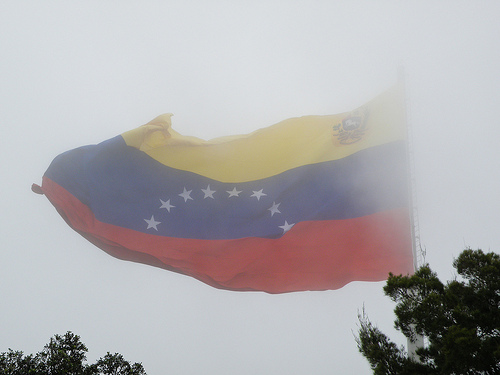
El Comandante’s illness leaves Venezuela on the brink of the unknown (Photo by JR2V published on Flickr under a CC BY-NC-SA 2.0 license)
On October 7, 2012 at 11:32 PM, Venezuelan President Hugo Chávez emerged on the balcony of El Palacio de Miraflores in front of thousands of supporters to accept re-election through 2019.
Thus ended months of speculation. Would Chávez, diagnosed with cancer in 2011, live to the election? Had urban voters soured on him and his Partido Socialista Unido de Venezuela (PSUV) amid soaring inflation matched only by spiking murder rates? Could the opposition coalition truly slay “the dragon of the tropics”?
A eleven-percent victory over the surprisingly disciplined Henrique Capriles provided resounding answers to these questions. With 80 percent electoral turnout, voters affirmed their support of Chavismo, the statist movement implemented by the Venezuelan strongman since his accession to the presidency in 1999.
Basking in electoral glory and red confetti, Chávez spoke of remaining in power until 2031. Opposition intellectuals retreated to Washington to lick their wounds and plead for unity moving forward. It would take time, one stated, teary-eyed at a downtown panel discussion, but eventually his side would overcome. The matter appeared to be settled, at least for the moment.
Two short months later, however, uncertainty has re-emerged with a vengeance in Venezuela.
 Alex Rosen
 Cornelius Fleischhaker
 gapolin1
 J. Elliot
 Jesse Rogers
 J.J.
J.J. kaypo9
 Mancha Contributor
 Samuel George
 theoakahn
 No Se Mancha